Blue Tier

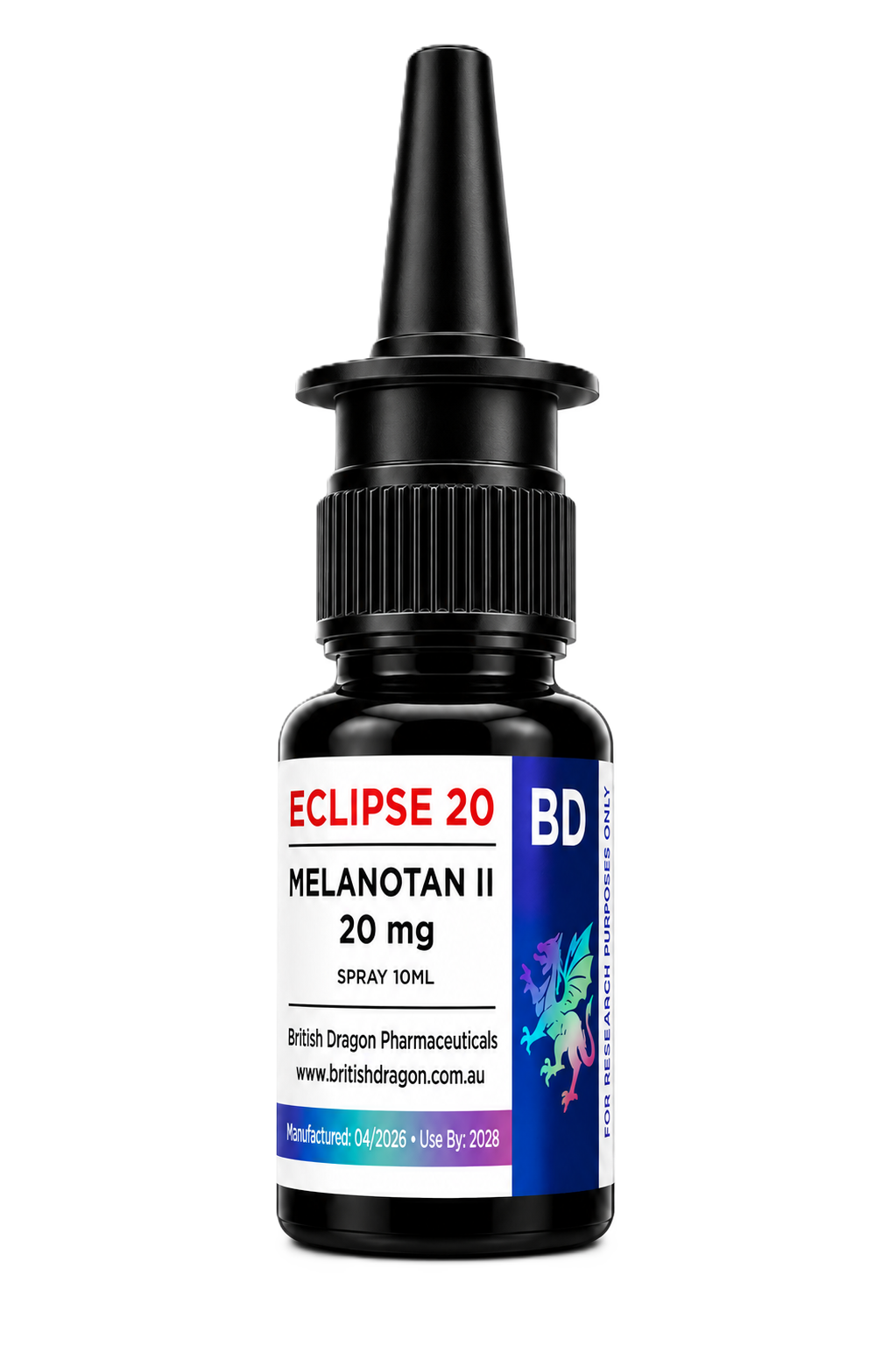
ECLIPSE 20

Melanotan II

Research-use-only cyclic melanocortin analog for MC-receptor signaling and stress-response studies.

  • Probes MC receptor signal dynamics.
  • Maps stress-response transcription.
  • ≥99% Pure | 5X Tested | PhD-Formulated | GMP/ISO

In stock

$100.00

Description

Melanotan II | Introduction

Melanotan II is a cyclic melanocortin analog used in RUO models to interrogate receptor-mediated signal transduction and cellular stress-response pathways. Studies often quantify MC-receptor engagement, downstream transcriptional effects, and redox-linked responses in vitro. Not intended for diagnostic or therapeutic use.

  • MC receptor engagement and bias profiling
  • Oxidative-stress response readouts
  • Signal kinetics and transcription mapping

Latest Certificate of Analysis.


View COA history.

NameMelanotan II
SynonymsMT-II
SequenceAc-Nle-Asp-His-D-Phe-Arg-Trp-Lys-NH2 (cyclic lactam, Asp2–Lys7)
Molecular FormulaC50H69N15O9
Molecular Weight1024.2 g/mol
CAS Number121062-08-6
AppearanceWhite to off-white lyophilized powder
SolubilitySoluble in sterile or bacteriostatic water
Purity≥99% (HPLC)
Storage Guidelines• Lyophilized: ≤0°F (–18°C), dry, protected from light/moisture
• Reconstituted: 36–46°F (2–8°C); avoid repeated freeze–thaw cycles
• Long-Term: Keep dry/frozen until use
  • Purity & Identity: ≥99% | HPLC & MS validated
  • Endotoxin & Sterility: <0.05 EU/mg | Third-party verified
  • Stability & Process: Controlled-nucleation lyophilization | Stability-focused procedures
  • Formulation & QA: PhD-formulated | GMP / ISO-aligned manufacturing
  • Packaging: Luxe Fridge-Ready Box

Signal transduction peptides are used in RUO studies to explore how cells send and receive messages. These signals help control how cells grow, repair themselves, and respond to stress. Researchers use these peptides in lab models to better understand how communication inside cells works—and what happens when it doesn’t.

Exciting Areas of Study

  • How cellular signals initiate chain reactions in lab models.
  • Peptide effects on messaging pathways like MAPK & PI3K.
  • How cells respond to stress in lab models.
  • Model disrupted signaling seen in pre-clinical disease research.

Research Applications

  • Map how cell signals change under different conditions
  • Test how peptides influence key response pathways
  • Study how signaling balance affects cell behavior over time
  • Profile MC receptor bias and downstream readouts
  • Quantify ROS/antioxidant pathway responses
  • Benchmark transcriptional signatures under stress

This product is intended solely for laboratory research purposes. It is not suitable for human, animal, or household use. Researchers must follow institutional safety protocols. See our Terms & Conditions and our Research Compliance Disclaimers for details.

Additional information

Select flavour

Strawberry, Watermelon, Bubblegum

Reviews

There are no reviews yet.

Be the first to review “ECLIPSE 20”

Your email address will not be published. Required fields are marked *

Third Party Testing

Lot number Analysis date Testing Certificate
LBL-1125-TSM10-1110 February 27, 2026 Purity & Net Peptide Testing View PDF
LBL-1125-TSM5-1051 April 23, 2026 Purity & Net Peptide Testing View PDF
LBL-0226-TSM10-1110 March 27, 2026 Purity & Net Peptide Testing View PDF
LBL-0326-TSM5-0004 March 27, 2026 Purity & Net Peptide Testing View PDF
LBL-0326-TSM10-0023 April 23, 2026 Purity & Net Peptide Testing View PDF

Knowledge Hub

Research & Education

Guides and reference material related to ECLIPSE 20.

  • Testing / COA Education

    Reading Lab Certificates of Analysis (COA): HPLC Traces & Mass Spectrometry

    A practical guide to interpreting analytical test reports: deciphering RP-HPLC chromatograms, understanding baseline integration, verifying electrospray ionization (ESI-MS) molecular mass, and evaluating third-party lab verification.

    Compound
    Retatrutide, mots-c
    Last reviewed
    Revision
    1.0
    Read guide: Reading Lab Certificates of Analysis (COA): HPLC Traces & Mass Spectrometry

Browse the Knowledge Hub

  • Testing / COA Education

    Reading Lab Certificates of Analysis (COA): HPLC Traces & Mass Spectrometry

    A practical guide to interpreting analytical test reports: deciphering RP-HPLC chromatograms, understanding baseline integration, verifying electrospray ionization (ESI-MS) molecular mass, and evaluating third-party lab verification.

    Compound
    Retatrutide, mots-c
    Last reviewed
    Revision
    1.0
    Read guide: Reading Lab Certificates of Analysis (COA): HPLC Traces & Mass Spectrometry
  • Handling / Storage

    Peptide Reconstitution & Storage: Preserving Lyophilized Cake Stability

    Essential laboratory guidelines for reconstituting lyophilized peptides: selecting diluents, minimizing shear stress during fluid introduction, temperature cycling parameters, and optimal freeze-thaw mitigation.

    Last reviewed
    Revision
    2.0
    Read guide: Peptide Reconstitution & Storage: Preserving Lyophilized Cake Stability
  • Comparison

    Wolverine 20: BPC-157 & TB-500 Synergistic Tissue Repair Pathways

    Examining the multi-modal angiogenic and cellular migration dynamics when pairing stable gastric pentadecapeptide BPC-157 with actin-sequestering peptide TB-500 in tissue culture and connective tissue assays.

    Compound
    bpc-157, tb-500
    Last reviewed
    Revision
    1.1
    Read guide: Wolverine 20: BPC-157 & TB-500 Synergistic Tissue Repair Pathways
  • Compound Guide

    Retatrutide (GLP-1 / GIP / Glucagon Tri-Agonist): Molecular Mechanisms & Preclinical Findings

    An in-depth biochemical review of Retatrutide (LY3437943), examining its multi-target agonist activity at GLP-1, GIP, and glucagon receptors, downstream cAMP accumulation, and energetic homeostasis in laboratory research models.

    Compound
    Retatrutide
    Last reviewed
    Revision
    1.2
    Read guide: Retatrutide (GLP-1 / GIP / Glucagon Tri-Agonist): Molecular Mechanisms & Preclinical Findings