
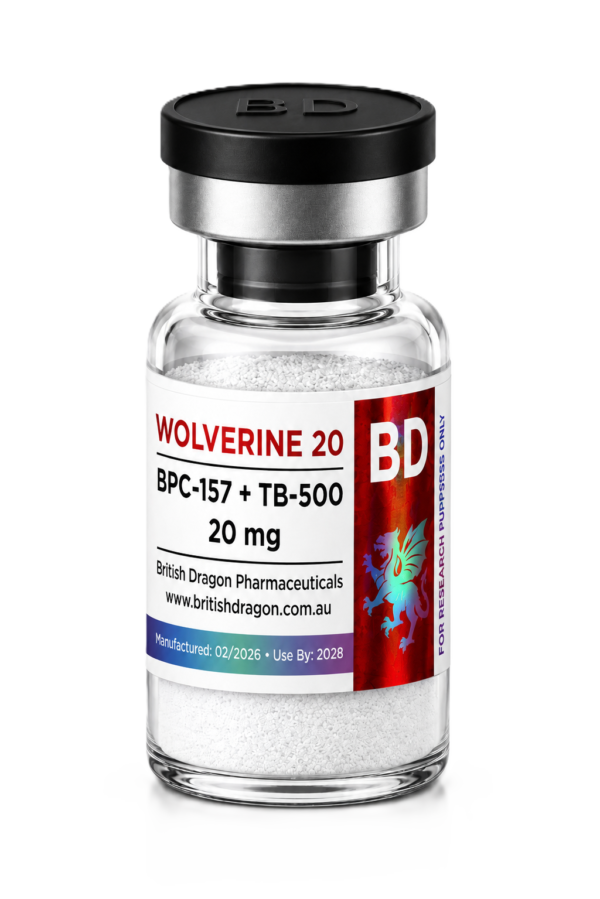
Wolverine 20: BPC-157 & TB-500 Synergistic Tissue Repair Pathways
Examining the multi-modal angiogenic and cellular migration dynamics when pairing stable gastric pentadecapeptide BPC-157 with actin-sequestering peptide TB-500 in tissue culture and connective tissue assays.
Dual-Mechanism Rationale (BPC-157 & TB-500)
The “Wolverine” research formulation combines two fundamentally complementary synthetic signaling peptides: BPC-157 (Body Protection Compound, 15 amino acids) and TB-500 (Thymosin Beta-4 active domain Ac-LKKTETQ, 43-amino acid derivative). In biological tissue repair models, neither agent exhibits cross-inhibition; rather, they operate along parallel, synergistic biochemical axes.
Mechanistic Comparison: Molecular Targets
| Parameter | BPC-157 | TB-500 (Thymosin β4) |
|---|---|---|
| Primary Target | VEGFR2, Early Growth Response Protein-1 (Egr-1) | G-actin sequestering & cytoskeletal polymerization |
| Angiogenic Mode | Direct endothelial collateralization via NO pathways | Endothelial cell migration & capillary tube assembly |
| Extracellular Matrix | Collagen type I/III crosslinking & tendon survival | Collagen deposition reduction & fibrotic scar remodeling |
| Nitric Oxide Role | Modulates eNOS and suppresses pathological iNOS | Downregulates inflammatory NF-κB signaling |
In Vitro Synergy in Tenocyte & Fibroblast Assays
Studies evaluating co-incubated tenocytes and dermal fibroblasts demonstrate that while BPC-157 induces rapid cellular proliferation and FAK-paxillin focal adhesion phosphorylation, TB-500 supplies the cellular motility necessary for wound margin bridging by regulating globular actin pools. This combined action achieves closure rates substantially faster than mono-peptide controls.
Storage & Reconstitution Parameters
Both peptides maintain excellent stability in lyophilized form. Following reconstitution with bacteriostatic water, the dual solution should be kept protected from ambient light at 4°C. Given the delicate quaternary structure of Thymosin beta-4, gentle swirl dissolution is required to prevent aggregation.
References
Peer-reviewed clinical & preclinical publications cited in this monograph.
-
1
Stable Gastric Pentadecapeptide BPC 157 in Cellular Angiogenesis Current Pharmaceutical Design Sikiric P, Seiwerth S, Brcic L, et al. Focus on ulcerative colitis: stable gastric pentadecapeptide BPC 157. Curr Pharm Des. 2011;17(16):1612-1632.
-
2
Thymosin Beta-4 and Dermal Wound Repair Mechanisms Annals of the New York Academy of Sciences Philp D, Badamchian M, Scheremeta B, et al. Thymosin beta 4 promotes dermal healing and endothelial cell migration. Ann N Y Acad Sci. 2007;1112:350-362.
Related Compounds, Tiers & Certificates
Referenced Research Compounds
Verified pharmaceutical grade peptides available for analytical research.
-
- Sale
 PREMIUM PEPTIDE STORAGE CASES
Red Tier Case
Original price was: $45.00.$40.00Current price is: $40.00.
Associated Product Tiers
Explore the full category portfolio under these research tiers.